






Javier Zamora’s journey from EL Salvador to the United States was only supposed to take two weeks but ended up being the worst nine weeks a child could have gone through.
Zamora, author of “Solito,” was interviewed by a four-student panel Nov. 5 in the Central High School auditorium. “Solito” is a memoir that tells the story of 9-year-old Zamora on his journey from El Salvador to the United States to reunite with his parents.
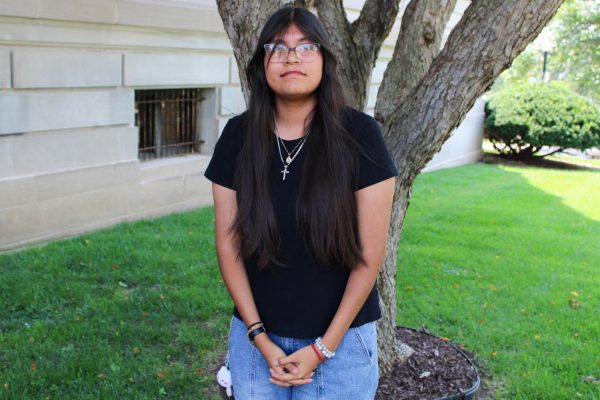
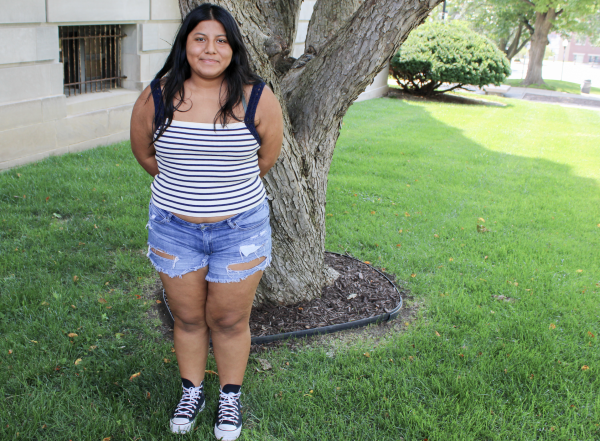
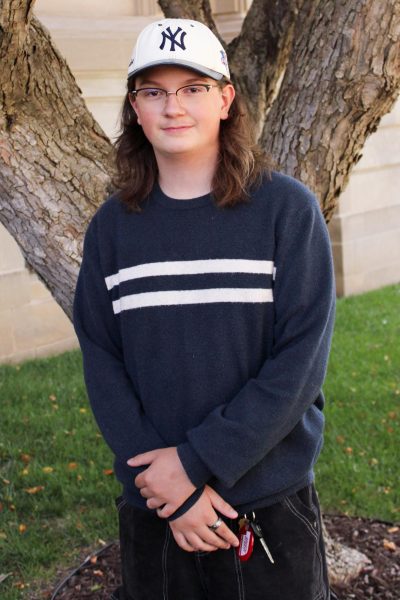
The four student panelists were senior Jasmin Gutierrez Garcia, senior Justin Pineda Choto, senior Gaby Antunez and junior Raquel Miranda. The event was organized by the English Learner department, Book Club and the Central High School Foundation. The interview was conducted in both English and Spanish which have been edited for clarity and length.
Gaby Antunez: “Solito” tells your story of migrating alone from El Salvador to the US when you were 9. What made you decide to share that deeply personal experience now?
Javier Zamora: Well, first off. Good morning, it’s an honor to be here. It’s my first time in Nebraska. Let’s see what made me share my story. Well, I immigrated when I was just nine years old in 1999. You can do the math. I’m 35, and from 1999 until I was 17— when I was about your age—I didn’t feel like I should tell or that I could tell anybody. Not my friends, not strangers especially, not teachers, about how I had gotten into this country. So, I hid my story until I started writing poetry. I didn’t like reading or writing, but around 17—I think in my senior year of high school—a teacher introduced me to the poetry of Pablo Neruda. That was the first time, in the English class, that we had read a poem that talked about a landscape similar to El Salvador. From then on, I began to tell myself the story of how I missed my country El Salvador, and then I went to college, and it wasn’t until I was like 20 that I really began to get into the ‘how’— how I had gotten here. Eventually when I was 29, I began to write what eventually became “Solito”. So, it took me a long time— I want to say 20 years—for me to even begin to tell myself everything that I’ve gone through because it was very difficult whenever I tried to remember it. I would get mad; I would get sad because of everything that I saw as a small child.
Jasmin Gutierrez Garica: How did writing poetry before “Solito” influence the way you wrote your memoir?
Javier Zamora: How did poetry influence my writing? I mentioned earlier as a 17-year-old ––the cool thing about poetry is that I hadn’t been an ELL (English Language Learner) student. English for me was a very difficult thing to learn and to read and write. I think because of the way that I learned it I didn’t necessarily like reading and writing. It took me being 17, around your age, when I realized that the teacher [that introduced me to the poetry of Pablo Neruda], what she said about poetry is that you don’t need rules. You don’t need to necessarily be an expert in English in order to write something. The other thing about poetry is that you can literally write one line and give it a title and put a period on it, and boom; that’s a poem. As a 17-year-old, knowing that gave me the power to believe in myself, believe that my story mattered.
At the time, we’re talking about 2006-2007, probably before you were born. At that time there wasn’t a book written by a Salvadoran, a book of poems written by a Salvadoran immigrant. I really wanted to read a book of poems written by a Salvadoran. Any Salvadoran, but particularly a Salvadoran immigrant. Fast-forward 10 years later in 2017, my book became the first book published by a poetry press by a Salvadoran. And now I think the power that poetry gave me as a 17-year-old is how eventually in my 30s again, I learned to believe in the power of writing and who I was and my story.
My memoir is the first memoir published in the United States by a Salvadoran immigrant. This goes to say that having that teacher tell me that pretty much that you can do anything and that anybody could read poetry went a long way and I think it’s the reason why I’m here with you tonight.
Raquel Miranda: Since we are on the topic of how you got to who you are now. I want to know how did it feel to relive those memories while writing “Solito”?
Javier Zamora: If you read the book, I left my country, April 6, 1999. My trip was supposed to take two weeks. My parents hired the same coyote (a person who guides Latin Americans across the US border) who brought my mom over in 1995. My dad left me when I was one. My mom left me when I was five and her trip took two weeks. The coyote was with her every step of the way, and she got here relatively safe.
That is what he promised her and when we left on April of 1999 I was supposed to get to the United States by April 16. But it is April 20, and we are still in Guatemala, and it was not just me in the coyote. It was 6 other adults, strangers, and another 12-year-old girl who were all from El Salvador. This trip, what followed, was something that took me a long time to really get out of my body because every time that I remembered it I began to not only get sad but sometimes cry, and shake.
In clinical science, you would call that PTSD, I have PTSD from being a small child from Guatemala. We took a 20-hour boat ride from Guatemala to cross into Oaxaca. In Oaxaca, the Mexican police pulled us out of the bus and pointed a gun at me for the very first time. It took us three weeks to go bus by bus and eventually get to the Sonoran Desert at the US and Mexico border.
At the border it took us three tries to eventually make it. Every try was very difficult. In one of them, we ran out of water. As a kid, my body didn’t really understand how close to death I was not once, not twice, but multiple times. As an adult, the older I got it is like your brain gets detached from your body and so your brain is telling you that ‘everything is okay.’ But then every time that I watched the news or in 2006, politically it was a very similar moment to now. That immigrants were all over the news.
In my opinion, for the very first time. From 1999 to 2006, people didn’t really talk about immigrants. It was like we didn’t even exist, so we went from nonexistence into being very visible and that visibility really almost shocked me. I felt like everybody could see me. I felt like everybody could see my trauma, and everybody could see something that I was ashamed of. Around that time is when poetry began to literally takethis hurt, this pain, this shame, that I had inside my body, and I put it on a page.
I believe that is the power of writing. Not only poetry, but any sort of writing you literally can expel those shakes that I had; you can expel the tears that I have inside. It was almost like my first type of therapy and at the same time I was also in therapy, but it didn’t really work for me. I was in therapy because I wasn’t a good student. I was a good student academically, I had good grades, but my attitude was bad. I was made to go to therapy starting in sixth grade because I would speak out. I would even sometimes, not saying to do this, please don’t do this, but I would throw stuff at my teachers.
I was that mad. Because I had a lot of anger for the way that I was perceived as a recent arrival or people at the school called me a newcomer. I hated that term; I felt different. And so, writing for me was the way that I learned to control or learn to control that anger and that pain.
Justin Pineda Choto: If the journey had never happened, what do you think you would have become? Do you mourn that version of yourself?
Javier Zamora: I don’t know. It’s weird to say, but I can’t even imagine who I would be in El Salvador because if the journey hadn’t occurred that would mean that I would have stayed in El Salvador. Historically speaking, if I had stayed in El Salvador in the 90s, there weren’t many options for me. In my elementary school that I went to, a lot of us left. We came to the United States. The friends that I grew up with that stayed either ended up being Evangelist pastors or joined the gangs, and some of them nothing good happened.
That is not really talked about, the ‘why’ we leave our countries, and a lot of those reasons are that our own countries don’t really believe in us, or they don’t invest in us. I’m from a very small, rural, poor area. In El Salvador, similar to a lot of places in Latin America, if you are born in such areas or if you don’t come from a rich family, education is not a thing that you could do. I always wonder and I always like to say that had I stayed in El Salvador, I would have never been a writer. I would never have had the life that I have now. It’s weird to say because I almost feel like I had to immigrate. That I had to come here.
Gaby Antunez: Your book shows how much you missed your parents during your journey. How has your relationship with them changed since?
Javier Zamora: What I went through was something that my parents, who were undocumented when I got to this country, almost like coached me not to tell anybody and we’re talking about safety. They were afraid that I was going to tell my teachers and that the teachers were going to tell. At that time, ICE (U.S. Immigration and Customs Enforcement) was called INS (Immigration and Naturalization Service) and because of that I also learned to hide this story. As a 9-year-old, as a 10-year-old, that was fine, I didn’t have any questions, or I didn’t push back against my parents. But in those years, I never had an outlet to talk about what I felt inside.
Once the hormones kicked in when I was 11, 12, and 13, I became an angry teenager. Our relationship got hard because I started to tell my parents this: “Why did you bring me here? I hate it here. This country sucks. Why don’t we go back? Why don’t we just leave everything? El Salvador is warmer. I miss the food. I miss my grandparents, etc.” Our relationship got strange. It didn’t begin to get repaired until I started writing in high school with poetry. In my 20s, I was still angry because something happens once you begin to remember, and you remember things differently than how your parents remember it, or your grandparents remember it.
In that remembrance, there is an opportunity to talk. Sometimes my parents wanted to talk, sometimes my parents didn’t, but I’d like to say that writing also brought us together because they could or had the opportunity to apologize for a lot of things. I had the opportunity to apologize to them for being angry at them so much and so writing helped us.
Jasmin Gutierrez Garcia: What was the most difficult scene to write and what made it so difficult?
Javier Zamora: This is not my first book. I have a book of poems. In the book of poems, I only talk about 80 pages. In the 80 pages, let’s say 10, it’s about crossing the border. And the most difficult, and the first memories that I wrote in this book, the prosa, “solito”, was the scene in which I am in the Pacific Ocean. In that sense, I think, there is a lot of people talking about the train to get to the border. There is a lot of talk about buses, cars, caravans that people take. But it’s not a lot of people talking about the lanchas, the boats that we also have to take. For example, to pass the Pacific or even sometimes to pass the Caribbean. So, in my 30 years, for the first time when I started writing this book, I put myself in that boat, and it was very difficult. But after completing that scene, I realized that I could chat and talk and everything else.
Raquel Miranda: What would you say to young immigrants today who feel like giving up school because the political climate makes them feel unwelcome? How can they reclaim their right to dream even though someone told them not to?
Javier Zamora: That’s a good question; I have to be completely honest, and I felt the same. I felt the same being undocumented as a high schooler. I don’t know about Nebraska, but in California it would’ve been impossible, not impossible, but really hard as an undocumented student to go to college. In California up until 2006, we were treated as international students. Even going to community college, I would have had to pay out-of-state tuition. Back then there would have been a difference between $500 at the community college had I been considered a California resident to $10,000. It’s like a huge jump, but fortunately in 2006 California passed this law that undocumented students were treated as California residents.
I hope that Nebraska is the same, but if it’s not, even knowing that as a 16-year-old or 17-year-old, I began to feel that my pathway to education was going to be difficult or more difficult than somebody born in this country. That really pissed me off. I was angry because I had good grades. I may not have behaved well, but if I had good grades, the only difference, the only thing keeping me from getting an education, was the fact that I wasn’t born in this country.
This is where therapy didn’t really work then, but then writing also calmed me down, but I feel your anger. I think you should be angry, people that tell you not to be angry don’t know what they are talking about. My job for you is to tell you that I feel you. I felt the exact same, and it feels like the world is out to get you, and that the world doesn’t understand you, and honestly, it doesn’t. The world didn’t understand me, and I will really encourage you to use that anger or to use that sadness to propel you to push forward and to keep pushing forward because that was the only thing that kept me alive and above water. I was so angry, and I needed to prove to other people, but also to myself, that I can do it.
In my bio, you can see that anger took me to University of California, Berkeley which at the time was the number one public university in the world. It took me to New York University, which still is the most expensive university in the world, but they gave me a full ride. It took me to Stanford, the number two university in the world, and it took me to Harvard. Saying those things, I’m not saying that college is the answer. I’m not saying that getting a diploma is the answer. For me it was, but going there now I can tell people, and I can tell you that diplomas don’t define you. You know going to college doesn’t tell you that you deserve to be here. Honestly, [expletive] that. You deserve to be here just for who you are, and you deserve to feel what you feel because what you feel makes sense.
This president right now is literally telling us that he doesn’t want us here, and so I encourage all of you to push the adults around you and some of you are becoming young adults as well or already are, but you are the answer that we need. You can and have the power to change the way that society views you. It might be hard to believe, but I wish that there was somebody that looked like me that spoke to me when I was in high school. That didn’t exist, and I wish that somebody was as honest or that told me you should be angry and maybe going to college is not the thing for you, but I still encourage you to do so and go to college because it changed my life. Just keep at it and believe that you could do something and that you do belong here, because every single day when I used to wake up, I felt like I didn’t belong here. I still do sometimes as an adult, and maybe a lot of adults around here also feel the same. It’s good to talk about how we feel, and writing for me was the tool that I used and the tool that I needed in order to feel that.
Justin Pineda Choto: How did writing “Solito” change your relationship with silence?
Javier Zamora: For a long time, I felt like I did not fit in with society. That the presidents like the president we have right now did not want me in this country. Because of that, when I was in high school, I kept quiet. The first time I realized that there is a lot of power in raising your hand and saying or telling or even writing what I feel. Let’s see, because many of the adults around you sometimes tell you if you keep going to school, if you keep quiet, following the rules, go to university, life will be easier. Many times, my father kept saying be quiet, don’t say anything, don’t ask too many questions. On my book of poetry, I was still realizing at 25 years old that it is necessary to speak honesty. We have to question the things we have now, because society should ask questions, if we don’t ask questions, if we don’t suggest other options, we get the president we have now.
Audience Question #1: Would you say America is still worth immigrating to?
Javier Zamora: Wow, great question. I’ll tell you this I couldn’t leave the United States for a long time because I didn’t have a green card. From 1999 until 2018, I didn’t have that privilege.
For 19 years I felt trapped in this country and when I finally left, for the first time I could see the United States from the outside. If I were to compare El Salvador to the United States, the United States is still better. We have a dictatorship right now. Everything that I said on this stage, I couldn’t say in my country. If I were to critique the president, I’m afraid to critique the president publicly and so there’s that big difference.
If we were to compare those two, yes, it is still worth coming here. Eventually just this year I went to Italy and Spain for the first time. I’m not saying that Europe is the answer but the way that I felt in those countries I was surprised by how little anxiety I had.
When I saw a cop, I didn’t feel afraid because surprisingly the cops in Italy actually help you. The cops in Spain actually ask questions and they aren’t quick to draw their gun at people of color. My wife felt safer walking at night. What I didn’t know is that if you overstay your visa particularly, I’m talking about the El Salvador case. If you’re Salvadoran and you have a Salvadoran passport you don’t need a visa to go to Spain.
Let’s say you go over there, and you decide to stay; you overstay your visa, it’s technically bad. It’s a crime but if you don’t commit any crimes and if you pay rent for two years, you can get the equivalent of a green card and after two years for 2 to 5 years if you don’t do anything bad you can become a citizen. What a concept. Right, if you don’t do anything bad and you’re paying your bills, you get to stay, which is a huge difference, and it just really opened my mind as to why do I wanna stay here.
My mom has TPS, my two aunts are undocumented and I’m always afraid every single day that something is gonna happen to them. Right now, I’m trying to encourage them like this isn’t the only way; this isn’t the only life that you could have.
The world is much bigger. So, in that particular case, I’m literally talking to my parents and my aunts about a backup plan and the backup plan would be like let’s say that they get deported tomorrow. I’m going to encourage them not to stay in El Salvador because it’s not safe either and to go to Spain. And so, to answer your question if it’s still worth coming here, it depends.
Audience Question #2: How does it make you feel to come to schools and share your stories and answer questions from people of similar backgrounds?
Javier Zamora: It makes me feel good, and I hope you know it is hard. I always want to be more hopeful, and I hope that you understand that I am hopeful, and I still believe in the world.
We are talking about very difficult things. We’re talking about trauma and it’s important especially as a man. It is my message to tell other people that therapy can help and that writing can help. That it is okay to cry. When you survive something, for me, it took me years to really learn that it was okay for me to share my feelings and that it was okay for me to cry and to feel everything.
A very toxic trait of patriarchy is that us men are taught to not do those. Especially when talking to people your age, nobody told me that. I wish that people would tell me that when I was your age because it would have saved me so many years and so many difficult scenarios in order to finally be like you know what I don’t feel okay I need to go to therapy.
You know what it is okay for me to cry. It is okay to feel the way that I feel, and I really need professional help. My message is not only about immigration, but it’s also has become about therapy and if I could plant a little seed in just one of you in this room I feel good. I think it is important to visit as many places as possible and to keep the hope alive.
To remind people that you aren’t as alone as you think you are because when you suffer in silence, and when you suffer silently the suffering gets much bigger, but it doesn’t have to be that way. So sharing that I felt like how you felt when I was your age might make you feel less alone.
Audience Question #3: What would say to students who are 16, 17 years old but find English difficult? You said you were 9 it was easy for you, but what would you say to those students who feel like giving up on their education?
Javier Zamora: I shared the story of my dad who came to his country when he was 21 and before he immigrated in El Salvador we had a Civil War from 1980 to 1992. He was good at school, and he really wanted to go to college but because of the war, he never got to do it.
He came here at 21 and he began by working during the day and at night he started taking English classes at the local community college he did that for five years and after five years, he learned enough English that he could take the regular classes and then he took landscaping classes because he really loved landscaping.
Eventually it was not until he was 44 so we are talking about 23 years later that he had an enough credit that he applied to college and what I did not mention is that the college that he went to was University of California Berkeley. He eventually graduated from University of California Berkley with an architectural degree at 47.
It is never too late for your dream but what I said is that you need a dream first, and that is what high school is for. Learning what you like, but you do not like, and then I shared that for me it took longer than high school it took longer than college because in college I did not study or get my diploma in English or creative writing.
I got my diploma in history and I really used to think that I wanted to be a historian but then I didn’t love it, the point of life and education I think it’s for you to find something that can truly love because when you find something that you love, it doesn’t feel like work.
And when it does not feel like work you can thrive. I kept on saying do not give up because my dad did not give up. He had a dream, and it took him a long time, but life is long.
Life is not short right now you have this goal line of like 18 I am going to graduate and then it is over. No life keeps going and it is never too late. If you didn’t do the thing that you wanted to do when you were 18 or 20 or 25 or 30 if you really believe in that dream and if you really love what that dream can do for you, it is never too late and don’t give up.
It might take you being 47 to graduate from college, but you know it does that and that is okay.